Standard Seal Range
Seals by Brand
Cartridge Seals
Seal Refurbishment Services
Elastomer Chemical Compatibility
Seal Face Chemical Compatibility
SEAL IDENTIFICATION
The process below demonstrates the correct procedure of measuring and properly identifying a mechanical seal in 3 easy steps:
STEP 1: IDENTIFYING SEAL TYPE & ARRANGEMENT
A mechanical seal can be identified, often visually, by looking out for how it's mounted to the shaft:
RUBBER BELLOWS MOUNTED
- Diaphragm Seals
O-RING MOUNTED
- Parallel Spring
- Conical Spring
- Multi Spring
- Wave Spring
- Metal Bellows
- PTFE Bellows
A mechanical seal can also be identified by arrangement:
DOUBLE SEAL
- Back-to-back
- Face-to-Face
- Tandem
SINGLE SEAL
- Internally Mounted
- Externally Mounted
STEP 2: IDENTIFYING SEAL SIZE & MATERIAL
In determining the size of your mechanical seal, use a precision measuring tool, ideally a set of vernier calipers to measure the following:
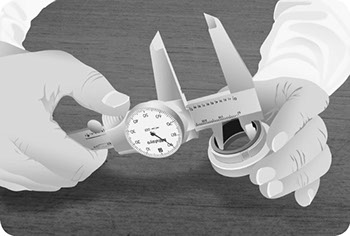
MEASURING & DETERMINING SHAFT SIZE
The shaft size, often denoted as 'D1', can be measured either:
1. Directly on the shaft where the seal is mounted or;
2. The inside diameter (ID) of your mechanical seal where for:
a) Rubber bellow mounted seals is the ID of rubber bellow
b) O-ring mounted seals is the ID of the O-ring
IDENTIFY THE SEAL FACE MATERIALS
Common seal face materials can be identified visually:
Carbon (CAB):
Ceramic (CER):
Silicon Carbide (SiC):
Stainless Steel (S.S):
Tungsten Carbide (TC):
Black in colour, rough to touch
White in colour, smooth to touch
Blue-grey in colour, smooth to touch
Metallic, smooth to touch
Similar to S.S, heavier, smooth to touch
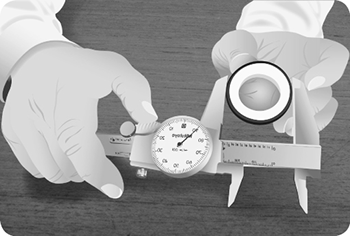
MEASURING STATIONARY TYPE, CAVITY & HEIGHT
Determine the style of your stationary, the two most common being
cup mounted or o-ring mounted.
To measure cup mounted stationaries:
1. Measure the outside diamater (O.D.) of the rubber cup (D7)
2. Measure the height (L4) from the rubber cup to the seal face
To measure o-ring mounted stationaries:
1. Measure the OD of the o-ring
2. Measure the height where for:
a) o-rings located in the middle, from the back face to front face
b) o-rings located in the back, from the back face to the o-ring
STEP 3: IDENTIFYING SEAL BY PUMP DESIGNATION
Often your pump type, manufacturer or model number can be used to determine whether the mechanical seal is standard or pump-specific:
DETERMINE THE PUMP TYPE & MANUFACTURER
Determine what type of pump, i.e. centrifugal, submersible, lobe, gear, agitator or compressor
Determine what pump brand, i.e. Grundfos, Ajax, Alfa Laval, APV, Ebara, Flygt, Inoxpa & Southern Cross etc.
IDENTIFYING THE PUMP MODEL & SIZE
Each pump manufacturer has their own designation or type key for their respective pump ranges.
We can normally determine the seal if you send a photo of the pump's nameplate