Standard Seal Range
Seals by Brand
Cartridge Seals
Seal Refurbishment Services
Elastomer Chemical Compatibility
Seal Face Chemical Compatibility
SEAL FACE MATERIALS
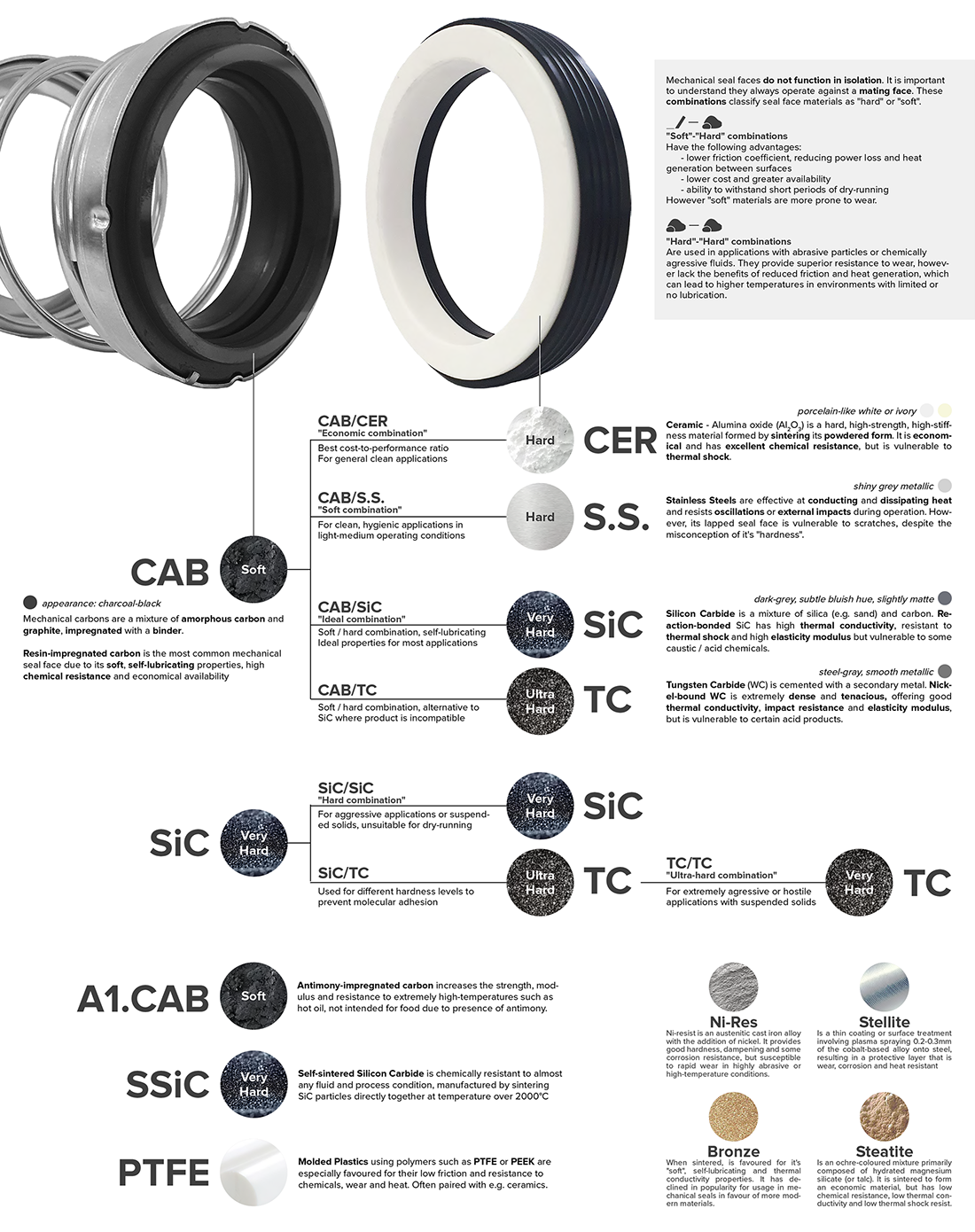

DETAILED INFORMATION
CARBON
Carbon is a highly abundant and versatile element, forming the basis of all organic products and processes. It exists in various forms, including amorphous carbon, graphite, diamonds, and fullerenes, and is valued for its inertness, stability, and self-lubricating properties. Mechanical carbons, used in seals, are blends of amorphous carbon and graphite, with their properties influenced by the percentages of each, as well as additives and impurities from raw materials like lampblack, charcoal, or coke. The manufacturing process involves blending, pressing, and heating in an inert environment, followed by vacuum impregnation with materials like thermoset resins or antimony metal to enhance strength and impermeability. Despite the production of hundreds of carbon grades, the mechanical seal industry standardizes on a limited number of grades, with the industry seeing consolidation among manufacturers
RESIN IMPREGNATED CARBON
Resin impregnated carbon is a blend of amorphous carbon/graphite and thermoset resin, making it the most common carbon type for mechanical seals in industry. Available in various grades, it withstands strong acids and bases, offers good frictional properties, and has an adequate modulus to control pressure distortions.
ANTIMONY IMPREGNATED CARBON
Metallized carbons contain metal impregnants like copper, bronze, lead, and antimony, with antimony being the most effective for seal applications. It enhances strength and modulus, making it ideal for high-pressure use. Additionally, antimony impregnated carbon resists blistering in high-viscosity fluids and light hydrocarbons, making it the standard for refinery applications. However, its chemical compatibility is limited by antimony, so consultation with carbon manufacturers and OEMs is recommended.
CERAMIC
Ceramics are nonmetallic, nonorganic materials that require high-temperature processing. In engineering, they are valued for high hardness, stiffness, low thermal expansion, and wear resistance. Common mechanical seal ceramics include silicon carbide, tungsten carbide, and alumina oxide, while silicon nitride is used for specialty applications. Properties like thermal conductivity, shock resistance, strength and impact resistance vary by material and manufacturing methods. Chemical compatibility and corrosion resistance depend on both the ceramic composition and secondary materials.
OVERVIEW
Alumina oxide (Al₂O₃) is the most widely used oxide ceramic, ranging from 94% to 99% purity. It is a dense, homogeneous ceramic with high hardness, strength, stiffness and excellent dielectric properties. Commonly used in electrical insulators, wear-resistant components, grinding media, and high-temperature applications, it also has excellent chemical resistance to most process fluids, except some strong acids. However, alumina is prone to thermal shock, which can cause fracturing, limiting its use in mechanical seals where rapid heating or dry-running is a concern. Despite this, it remains widely used in stable thermal conditions.
SILICON
CARBIDE
Silicon carbide (SiC) consists of silicon and carbon atoms bonded in a highly stable structure, making it resistant to extreme temperatures and chemicals. It has high hardness and a high modulus, but its complex manufacturing limits its use in component design. Traditional reaction bonding has been used for production, with newer methods like sintering, chemical vapor deposition (CVD), and conversion processes applied in specialized areas. SiC is rare in nature, first identified in 1824 and commercially produced in 1892 using an electric arc furnace. This process creates large blackish-blue crystals, which are crushed for abrasives or further SiC processing.
REACTION BONDED SILICON CARBIDE
Reaction bonded silicon carbide (RBSiC) is produced by bonding SiC particles through a reaction process. A mixture of SiC, carbon, and a binding agent is shaped and then exposed to molten silicon metal in an inert atmosphere. The silicon reacts with free carbon, forming additional SiC that bonds the structure together. This results in a fully connected SiC matrix with 8–12% free silicon. While the silicon metal does not greatly impact physical or thermal properties, it reduces chemical resistance. RBSiC is vulnerable to attack from caustics, high pH chemicals, and strong acids, making it unsuitable for such applications.
SELF-SINTERED SILICON CARBIDE
Self-sintered silicon carbide (SSSiC) is produced by sintering SiC particles with nonoxide aids (e.g., C, B, Al) in an inert environment at over 2000°C. The result is a material made almost entirely of SiC, with minimal voids and exceptional chemical resistance, making it ideal for centrifugal pump applications. Early research used beta-phase SiC, while later advancements focused on alpha-phase SiC, though patents initially limited availability and slowed industry adoption. Some perceived SSSiC as more brittle than reaction bonded SiC (RBSiC), but no standardized tests confirmed this. It is also known as sintered SiC (SSiC), direct-sintered SiC (DSSiC), or alpha sintered SiC (aSiC)—all referring to the same material.
TUNGSTEN
CARBIDE
Tungsten carbide (WC) is a carbide ceramic known for its high hardness and toughness but is difficult to shape like other ceramics. It is typically produced as a cemented carbide, where WC particles are bonded with a metal binder rather than to themselves. This enhances toughness and impact strength but increases density. Cobalt-bound WC (Co-WC), introduced in the 1930s for cutting tools, became the standard for mechanical seals but lacked chemical compatibility. It was later replaced by nickel-bound WC (Ni-WC), which contains 6–10% free nickel and remains widely used for seal faces due to its high strength, toughness, and good chemical resistance, though limited by free nickel.